I returned yesterday from my holiday in America. It was a time of catching up with family and old friends and exploring a city that I called home for many years. I kept myself busy by going to art museums and the science center, bowling, the cinema, holding giggly babies, cooking for the family, playing games, going on long drives and even longer walks. It was a fun few weeks to say the least. Though I’m pretty jet-lagged from my travels, I have a recipe to share with you today.

As part of the Fabulous Fermentation Week, my two food blogging friends, Elenore from Earthsprout and Sarah from My New Roots, sent an email asking me to participate. I jumped with joy for the opportunity to work with these two lovely ladies. I want to celebrate Elenore and Sarah’s wonderful effort to spread the word about the great benefits of fermentation with some raw almond yogurt.

Probiotics are getting a big publicity boost in mainstream media these days. They have always been good for us, but now people seem to be talking about them more, which is a good thing. Acidophilus provides the health benefits of fermentation, the largest of which is the introduction of probiotics into our system. A balance of good bacteria is necessary for optimal immune system functioning and intestinal health. In addition, fermented foods aid our bodies in absorbing vitamins (particularly vitamins C and B12), minerals and omega-3 fatty acids from food.

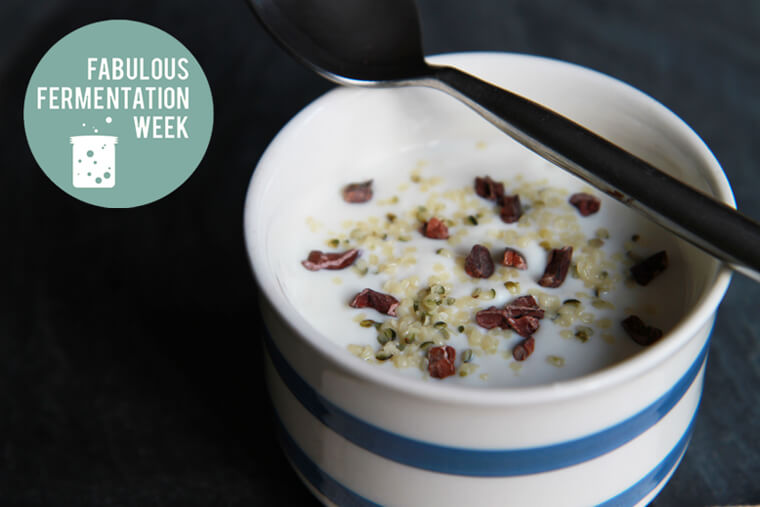
Probiotics are good to have in the morning, when your body will absorb them more readily. That makes this yogurt a great breakfast. Try adding fruits such as kiwi, pineapple, banana, peaches or fresh berries. I tried mine with a sprinkle of cacao nibs and hemp seeds. Delicious.
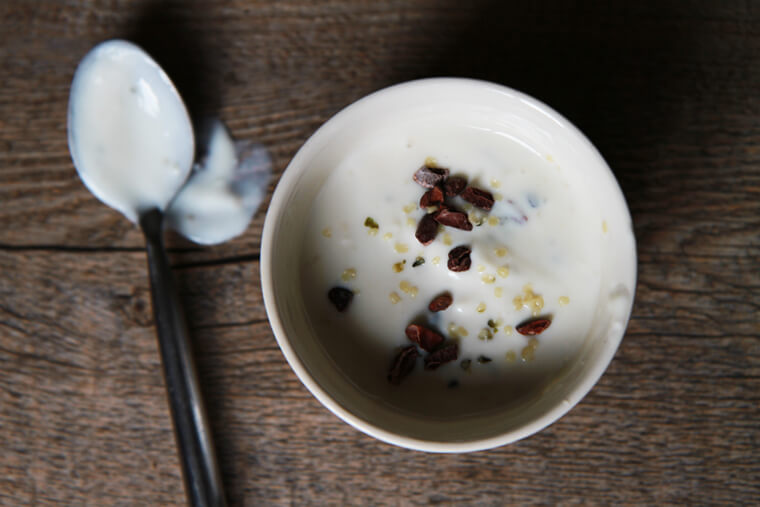
raw-yogurt

Raw Almond Yogurt

Vegan, Raw & Gluten-free

Makes about 2 cups

Ingredients:

  • 1 cup raw almonds, soaked in distilled water for 24 hours
  • 2 cups coconut water (or distilled water)
  • 1 Tbsp. maple syrup or honey
  • 1/2 tsp. probiotic powder (or the content of 3 probiotic capsules)

Directions:

  1. First, soak your raw almonds in water for 24 hours. Soaking the nuts will activate the dormant enzymes and release the nutrients. It also makes it easier to break them down in the blender.
  2. Add soaked almonds, coconut water (or distilled water), sweetener and probiotics to a high speed blender and blend until smooth.
  3. Next, using a fine mesh strainer or nut milk bag, strain the liquid into a glass bowl.  This will remove fibers and almond skins and will help achieve a creamy texture.
  4. Cover the glass bowl with a paper towel or clean dish towel and let sit at room temperature for 6-8 hours. This will allow the probiotics to proliferate and thicken the yogurt.
  5. Serve immediately or slightly chilled. Store covered in the fridge for up to a week.


20 Comments

  1. Caitlin says:

    i never realized it was so easy to make yogurt! this is a must try!

  2. Annie says:

    I am currently on a candida diet, so no sugars of any sort for me. I know that bacteria loves to eat sugar and was wondering if the probiotics could still grow with stevia or xylitol as their food. I don’t need the yogurt to be sweet. . .

    • Katie says:

      Hi Annie, thanks for stopping by! That is a fantastic question and I’ll try to answer it to the best of my knowledge. Though I haven’t experimented making this yogurt recipe without the use of sweeteners, I would presume it would turn out a little runny but still as yummy. You can absolutely add stevia or xylitol for sweetening if you so choose. Any way of getting those healthy bacteria in your body is a great plan – especially since you’re concerned with candida. I hope this helps and please let me know if you give the recipe a try! :)

  3. Sofia says:

    Wow, that looks so creamy! I tried culturing my almond milk with kefir grains in the past. It seemed to work and tasted great, but didn’t thicken at all. Will have to try the probiotics.

    • Katie says:

      Hi Sofia, thanks for stopping by! Maybe try it with probiotics and see if the consistency is better for you. I’ve only recently started experimenting with fermenting certain things – kefir grain is next on my list. Do you have a recipe on your blog?

  4. [...] My New Roots Green Kitchen Stories The Wooden Spoon Coconut and Quinoa Whole Promise Two Blue Lemons Golubka Eat It. Kyra’s Kitchen Ola Domowa The First Mess The Natural Foodie My Whole Food Romance The Holy Kale Kale & Cardamom Mince & Type Figgy & Sprout [...]

  5. Nancy says:

    Thanks for sharing this — the yogurt looks so thick and creamy! I’m going to give this a try next time I make a batch of almond milk. So glad to discover your lovely site through the fab fermentation week :)

    • Katie says:

      Hi Nancy, thanks for visiting! So glad we were able to take part in the fermentation week together! I look forward to connecting with you and trying out your recipes :)

  6. Heather Cardwell says:

    Hi – so excited by this recipe. I have just made my first batch! Just wanted to ask everyone if the almond pulp thats left is ok to use in other recipes as it seems a lot of goodness to throw away! Does anyone have any suggestions/ Thank you xx

    • Katie says:

      Hi Heather! Glad to hear you’ve made the recipe :) You’ll have to let us know how it turns out! I don’t let anything go to waste in my house – especially almond pulp. I bake it into cookies, breads or crackers. Here are a few recipes from the blog archives: Almond Pulp Crackers and Whole Wheat Berry Muffins. Enjoy!

      • Heather Cardwell says:

        Hi Katie! Thanks for your reply about the almond pulp! I love that you have recipes for it already!
        Just need some help with my yoghurt. I couldn’t get it to thicken enough, it stayed pretty runny. I wondered if it was the cold English winter but the house is pretty warm. Also I made it with coconut milk (the non dairy drinking kind not the cooking kind) rather than coconut water. Do you think that made a difference? I so want this to work as its a dream come true of a recipe! xx

        • Katie says:

          Hi Heather! I made this yogurt the other day without straining the almond pulp and it turned out nicely. It won’t be like any normal yogurt you may have tried, but it’s especially tasty and filling. It sounds like the temperature wasn’t warm enough for the the yogurt to culture. I don’t think using a different liquid would have made a difference. You could always add flax seed, lecithin or tapioca flour to help thicken it. Let me know if you try any of those things and I’ll be sure to keep you posted if I find a fix for you.

          • Lauren says:

            Hey, just scrolling through the comments and thought I would throw my two cents in here! Pop your oven on really low say 75-100c and leave it in there for four hours! English winters are much too cold for fermenting yogurt, I did this and it turned out great :)

          • Katie says:

            Hi Lauren, thank you for the great suggestion! It’s good to know this method works well. However, it should be noted the yogurt wouldn’t be considered raw since it is heated above 47c. I’m glad you are enjoying the recipe :)

  7. Sophie says:

    Hello Katie,
    I tried making this in a yogurt maker, but it didn’t work out to say the least. Instead of making a homogenous yogurt, a skim of yogurt (like material) 1cm thick formed on the top and the bottom of the containers were full or coconut water. Any hints on what went wrong ad why it separated?

    • Katie says:

      Hi Sophie, so glad you tried the recipe! I’m not sure what went wrong during your yogurt making. My first guess was the temperature wasn’t warm enough for the yogurt to culture, but since you are using a yogurt maker this isn’t the case. I’ve only made this recipe a few times but it was successful so I didn’t think about using any thickeners. I think next time I’ll try adding lecithin or maybe flax seed to see if that thickens the mixture and makes it more homogenous. Do let me know if you try any experiments of your own!

  8. lou says:

    this looks great! question. what brand of probiotic powder did you use as i know it is important to use one from a reputable source.

    • Katie says:

      Thanks Lou! I used the Sona brand of Acidophilus – it is a vegan probiotic. I purchased it at my local health food store in the refrigerated section.

  9. Yvette says:

    Hi there–very excited to try this! I have a kit for making dairy-based yogurt in my cupboard. Do you think the cultures from that kit would work with this recipe? (This might be a dumb question; I’m just not clear if the cultures used to make dairy and non-dairy yogurt are the same.) Thanks for any advise you can share!

Leave a Comment